A 3D configurator lets customers build your product on your website: they pick finishes and options, watch it change instantly, see the price and send you what they configured. Building one can cost anything from a few thousand to well over a hundred thousand. What makes the difference is how many options there are, which rules combine them and what it has to connect to.
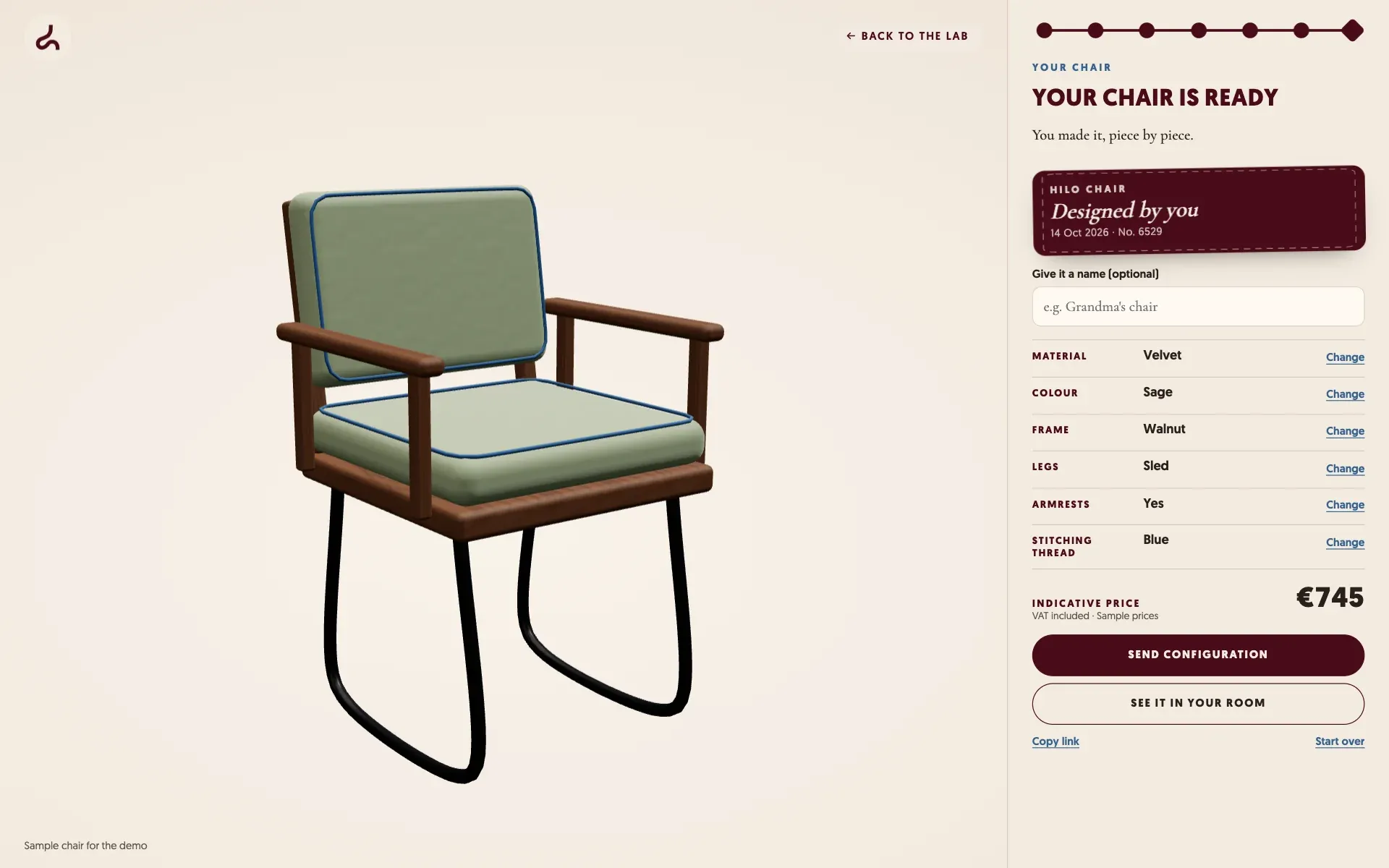
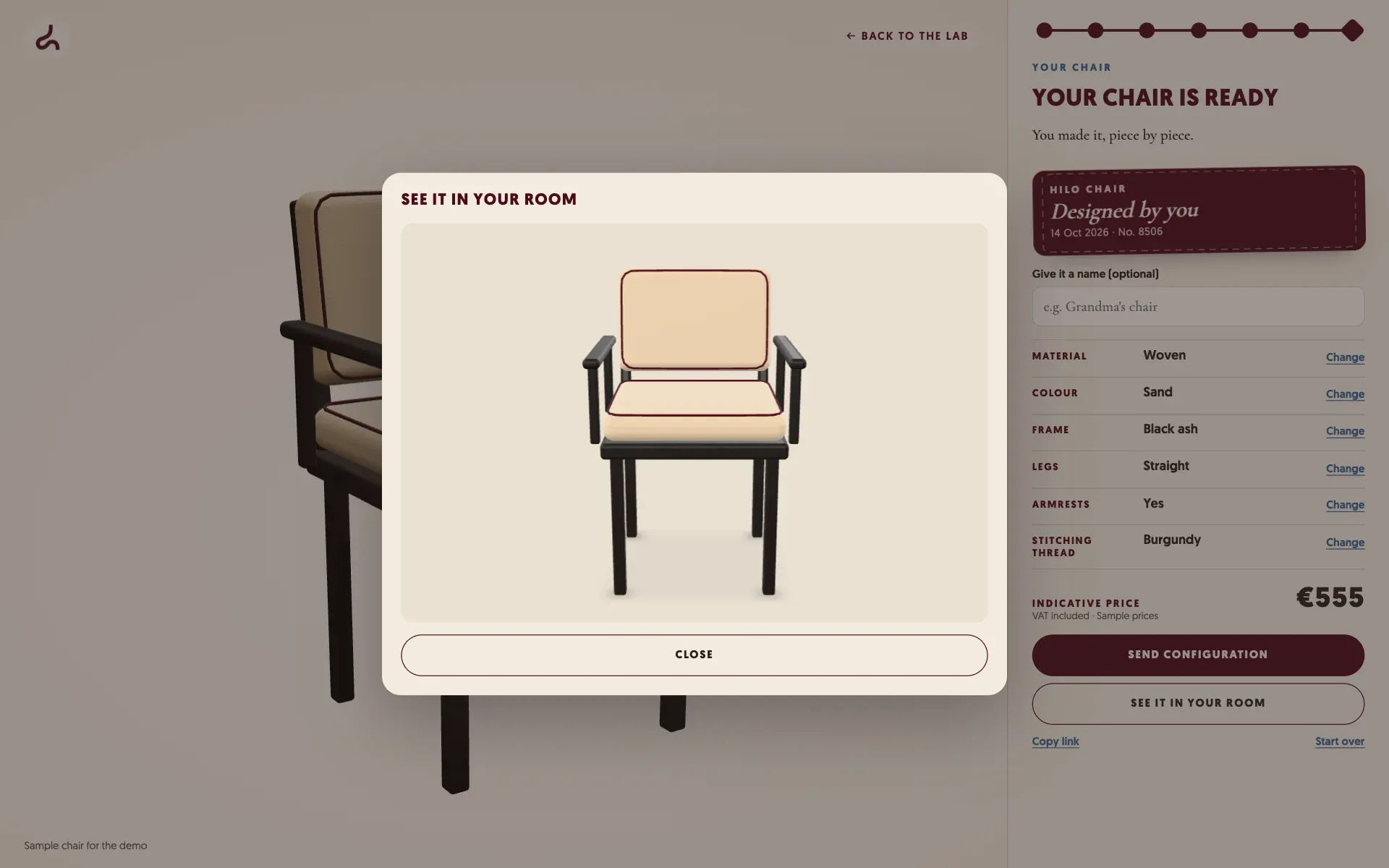
Before the numbers, try one. We built a configurator in the Lab around a sample chair: open it here, change the fabric, the wood and the legs, and watch the price change.
Price ranges in 2026
| Type of configurator | Typical range | What it includes |
|---|---|---|
| Demo or a single product with few options | $4k – $10k | One model, colour changes, a simple interface |
| Configurator with variants and live pricing | $10k – $30k | Material catalogue, swappable parts, sending the result |
| For manufacturers, with rules and integrations | €14,500 – €35,000 | Production rules, several products, ERP or CRM connection |
| Enterprise platform (full catalogue, CPQ) | $30k – $150k+ | Hundreds of SKUs, system sync, AR, manufacturing output |
| Subscription (ready-made platform) | $70 – $300 per month | Templates, product limits and a commission per sale |
Amounts exclude VAT. In Spain, where we’re based, a configurator with variants typically sits at €8,000–18,000. Sources: custom build ranges in 2026, Three.js configurator prices in Spain, manufacturer projects in Spain and Zakeke’s pricing.
What drives the price
1. The options and how they combine
Changing a product’s colour is simple. The cost comes when options depend on each other: this fabric doesn’t go with that frame, this size changes the price of that accessory. Those rules have to be defined, coded and tested, and that’s where most of the hours go.
2. Where the models come from
If you have CAD files, they’re prepared for the web. If the product has to be modelled from photos and measurements, add modelling: $150–1,500 per production-ready model, depending on complexity. A chair is quick; a machine with dozens of parts isn’t.
3. Materials you can tell apart
A fabric catalogue where bouclé looks like bouclé and velvet catches the light like velvet sells far better than a flat colour swap. Preparing realistic materials that still load fast on a phone takes work.
4. Augmented reality
Letting customers see the product at real size in their home is one of the most convincing features, especially for furniture and décor. If the configurator already generates the 3D model, adding AR costs relatively little. If you need a file for every combination, it doesn’t.
5. Integrations
Sending the configuration by email is the basics. Connecting it to your CRM, online store, ERP or quoting system is custom development, and it shows in the price.
6. Maintenance
Someone has to add new fabrics, change prices or retire a model. If you do it yourself from a panel, that panel has to be built. If the provider does it, maintenance plans start at around €190 a month as a reference.
Subscription or custom
A subscription (platforms such as Zakeke) costs $70–300 a month depending on the number of products, plus a 1.5–1.9% commission on every customised sale. It pays off if you sell on Shopify or WooCommerce, your product fits their templates and you want to start now.
A custom build pays off when the configurator is part of your brand: your own experience and rules, materials that look real, no commission per sale and no product limits. Also when what you want isn’t to sell online but to receive qualified requests: customers arrive knowing exactly what they want.
What you get at the end
This is what’s most often forgotten when comparing prices. A good configurator doesn’t end in a pretty image: it ends in a complete request. In our demo, tapping “Send configuration” delivers a message to the studio with every chosen option, the price and a link to reopen that exact chair. For a manufacturer, that means less email back-and-forth and faster quotes.
How to save without losing quality
- Start with one product, your best seller or the one that raises the most questions, and expand later.
- Share your CAD files and material photos: it saves hours of modelling.
- Write the rules down before asking for a quote: what combines with what and what changes the price.
- Decide what happens at the end: send an email, create an order or open a quote. It changes the work a lot.
Want a configurator for your product?
Get a quote →