
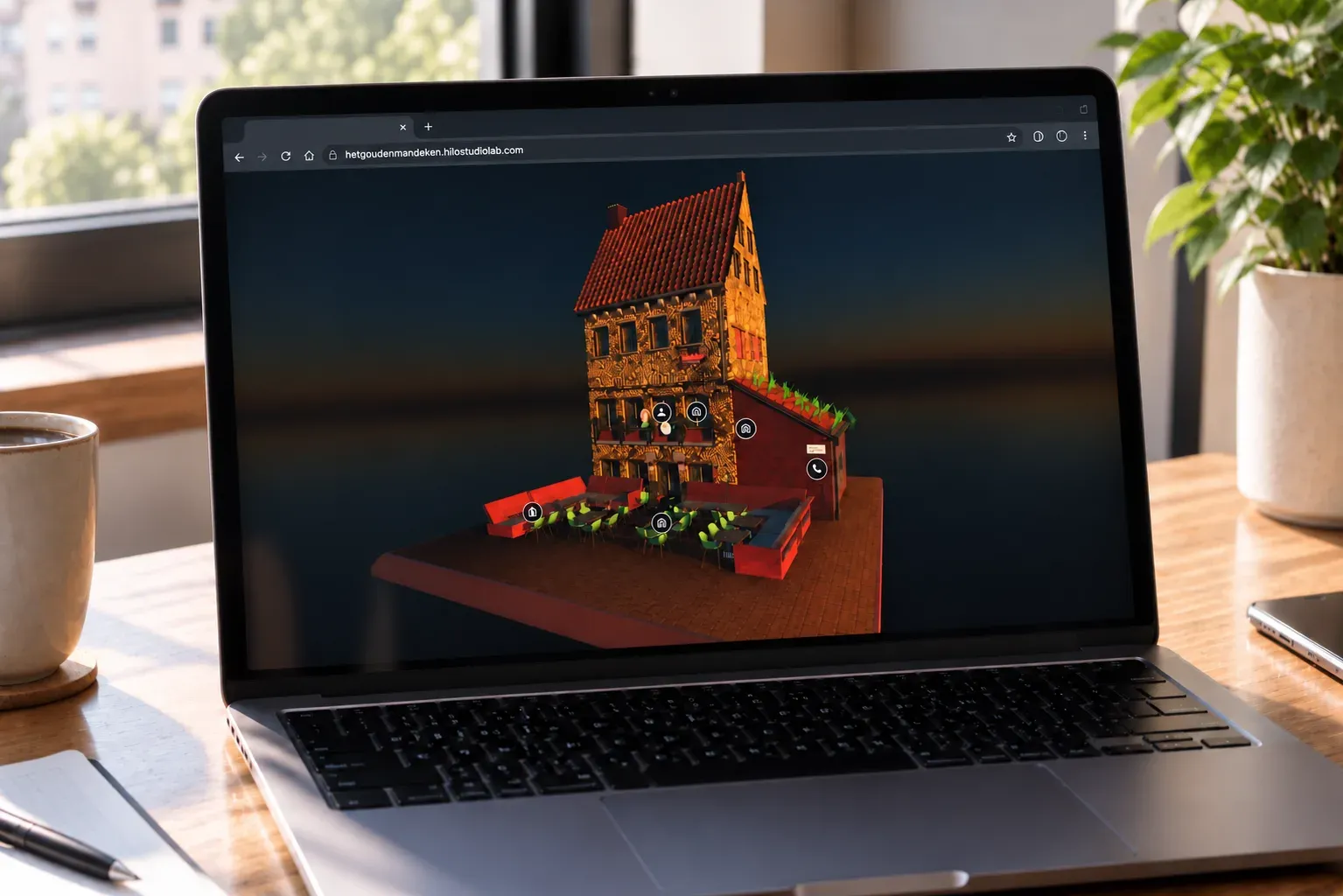
A 3D website can cost the same as a regular custom site or ten times more. The difference isn’t “having 3D” but how much 3D there is, where the models come from and what visitors need to do with them. Here are the ranges we see in Spain in 2026 and what sits behind each one.
What a 3D website actually is
It’s a normal website, with its text, menu and contact form, where part of the experience is a 3D model drawn in real time in the browser with WebGL. No plugins: it works in Chrome, Safari and on a mid-range phone. We build it with Three.js.
Here’s a real example: the menu of t’ Gouden Mandeken, a bar in Ghent. Rotate it with your finger or mouse and, on a phone, tap “View in your space” to place it on your table in augmented reality.
Price ranges in Spain (2026)
| Project type | Typical range | What it includes |
|---|---|---|
| Custom website, no 3D | €2,500 – €8,000 | Bespoke design, several pages, CMS |
| Simple 3D piece (one model, few interactions) | €2,000 – €5,000 extra | A product that rotates or reacts to scroll |
| Configurator with variants | €8,000 – €18,000 | Materials, options, live pricing, sending the result |
| Multi-environment or physics experience | €18,000+ | Team, QA, ongoing optimization |
Market sources: Three.js development pricing in Spain and web design pricing in Madrid. All figures exclude VAT.
What makes a 3D website more expensive
1. Where the model comes from
If you already have CAD files or a finished model, the job is preparing it for the web. Modeling from scratch from photos costs more. A bottle is quick; a whole building isn’t.
2. How heavy it is (and the work to make it light)
3D on the web almost always fails because of weight. A carelessly exported model can weigh tens of megabytes and crawl on mobile. Simplifying geometry, compressing with Draco or Meshopt, shrinking textures and lazy loading takes hours, but it’s what separates a 3D site that works from one people abandon. On the menu above we went from 2.4 MB to 267 KB: 89% smaller.
3. What the visitor does
Looking at a rotating model is cheap. Scroll that tells a story (like our Tabasco project), swappable materials or live price calculation is another league.
4. Integrations
A configurator that sends the configuration to your CRM or quoting system needs custom development, and that’s part of the price too.
When 3D is worth it (and when it isn’t)
It pays off when the product reads better in volume, when the place itself is the selling point (hospitality, real estate, events), or when you need people to stay and share.
It doesn’t if you need an informational site that loads instantly. There, animation and good design do the job for less. We’ll tell you before we quote.
How to save without losing quality
- Start with a single 3D piece where it helps sell the most, and keep the rest of the site light.
- Share your files (CAD, studio photos, dimensions): it saves modeling hours.
- Decide what the visitor should do before asking for a quote. “Rotate it” and “configure it” are different projects.
- Ask for content in HTML: you won’t pay twice, once for the experience and again to fix SEO.
Want to know what yours would cost?
Get a quote →